
Understanding Carbon Capture and Storage (CCS) in the Global Energy Transition
Carbon Capture and Storage (CCS) refers to a suite of technologies designed to capture CO2 emissions from industrial processes and store them permanently in deep geological formations. The process typically involves three main stages: capturing CO2 at its source, transporting the compressed gas to a storage location, and injecting it deep underground for long-term containment.
Read more:
How CCS Fits into Global Climate Mitigation Strategies
Global climate strategies frequently include CCS as part of a broader portfolio of decarbonization technologies. The International Energy Agency estimates that carbon capture and storage could contribute significantly to emissions reductions required to reach global net-zero targets. Since many industries rely on fossil fuels or carbon-intensive chemical reactions, CCS is critical because it allows emissions reductions without requiring complete replacement of existing industrial infrastructure.
Global Deployment and Capacity
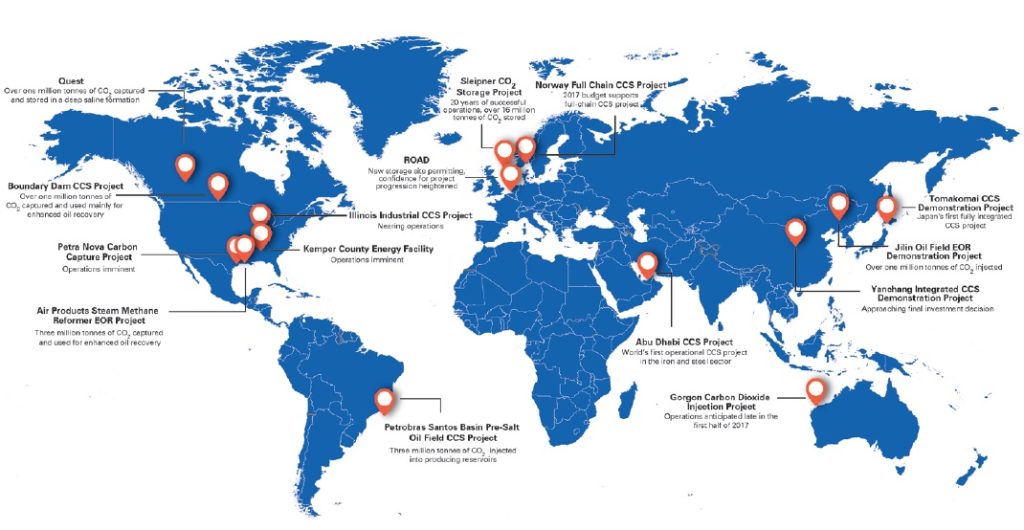
Carbon capture and storage deployment has expanded gradually over the past three decades. According to the Global CCS Institute, about 77 CCS facilities are currently operating worldwide, capturing over 60 million tonnes of CO2 annually. This represents a rise of over 50% year on year in facilities development as at year end 2025 with several projects undergoing construction. Global CCS Institute reports indicate that more than 100 projects are currently in development stages worldwide, reflecting growing investment in carbon capture technologies. This rapid expansion is largely driven by climate policy incentives, carbon pricing mechanisms, and government funding programs designed to accelerate deployment.
While the current global carbon capture capacity represents a relatively small fraction of global emissions, the technical potential for geological storage is extremely large. Peer-reviewed studies indicate that suitable geological formations worldwide could store thousands of gigatonnes of carbon dioxide which is enough capacity to handle centuries of industrial emissions at current rates. This vast capacity is distributed across every continent, primarily in deep saline aquifers and depleted oil and gas fields, providing most industrialized nations with a local solution for their carbon waste.
Regional Distribution of CCS Projects
North America Carbon Capture and Storage Initiatives
North America currently hosts some of the largest CCS projects in operation. The United States and Canada have developed several major facilities associated with power generation, natural gas processing, and industrial emissions reduction. Examples include projects in Texas, Alberta, and North Dakota that capture and store millions of tonnes of CO₂ annually. Government incentives such as tax credits have significantly accelerated development in the region.
European CCS Developments and Policy Frameworks
Europe has increased investment in CCS as part of its broader climate strategy. Several large CCS clusters are being developed in the North Sea region, where depleted oil and gas reservoirs offer suitable storage sites. Projects such as Northern Lights in Norway aim to transport and store carbon dioxide from industrial facilities across Europe.
Asia-Pacific CCS Projects and Emerging Technologies
Countries in the Asia-Pacific region are increasingly exploring CCS as part of their decarbonization strategies. Japan, China, and Australia have launched pilot and commercial-scale projects focused on industrial emissions reduction and geological storage. Australia’s Gorgon project is among the largest carbon storage operations in the world.
Middle East CCS Deployment in Oil and Gas Operations
The Middle East has begun developing CCS projects linked to industrial and energy operations. Several projects focus on capturing CO₂ from natural gas processing or steel production and injecting it into oil reservoirs. These projects often combine carbon storage with enhanced oil recovery.
Carbon Storage Opportunities in Africa and Latin America
CCS development in Africa and Latin America remains limited but is gaining attention as governments evaluate strategies for managing industrial emissions. Geological surveys suggest that both regions possess significant storage potential in sedimentary basins.
The Global CCS Institute highlights that cross-border collaborations are becoming a strategic necessity for the industry. These international partnerships allow different countries to share infrastructure including shipping and storage potential which creates economies of scale and significantly lowers the high cost of entry for smaller nations. By working together, a country with high emissions but no storage space can send its CO2 to a neighbor with vast underground reservoirs. This teamwork is the fastest way to build a global “carbon backbone” that works for everyone.
Major Operational Carbon Capture and Storage Projects
Industrial Carbon Capture Projects in Power Generation
Power plants have been early adopters of carbon capture technology, particularly in regions where coal or natural gas remains a major energy source. Several large-scale power generation CCS projects have demonstrated the feasibility of capturing significant portions of emissions from fossil-fuel power plants.
CCS Projects in Natural Gas Processing Facilities
Natural gas processing facilities frequently remove CO2 from raw gas streams before distribution. In some cases, this CO2 can be captured and stored rather than vented to the atmosphere. This type of CCS application has been implemented in several commercial projects.
Large-Scale CO2 Storage Projects in Depleted Oil and Gas Fields
Depleted oil and gas reservoirs are often considered ideal storage sites because they have already demonstrated the ability to contain fluids over geological timescales. Existing infrastructure also reduces development costs.
Carbon Storage Projects in Deep Saline Aquifers
Deep saline aquifers are widely regarded as the largest potential storage resource for carbon dioxide. Several large-scale projects currently inject CO2 into these formations.
Industries Leading Carbon Capture Deployment
Carbon Capture in the Cement Industry
Cement production generates significant CO2 emissions due to the chemical process of calcination. CCS technologies offer one of the most promising pathways for reducing emissions in this sector.
CCS Applications in Steel Manufacturing
Steel production also produces substantial carbon emissions. Carbon capture technologies are being explored to reduce emissions from blast furnace operations.
Carbon Capture in Chemical and Hydrogen Production
Hydrogen production facilities often produce concentrated CO2 streams that are relatively easy to capture and store.
Integration of CCS in Power Generation Systems
Power generation remains an important sector for CCS development, particularly in regions where fossil fuels continue to dominate electricity production.
Technologies Driving the Expansion of CCS Projects
Post-Combustion Carbon Capture Technologies
Post-combustion capture systems remove CO2 from flue gases after fuel combustion. This approach can be retrofitted to existing power plants.
Pre-Combustion Carbon Capture Systems
Pre-combustion capture involves converting fuel into hydrogen and CO2 before combustion. The CO2 can then be separated and stored.
Oxy-Fuel Combustion Capture Methods
Oxy-fuel combustion burns fuel in pure oxygen instead of air, producing an exhaust stream that contains a high concentration of CO₂.
Direct Air Capture with Geological Storage
Direct air capture technologies remove CO₂ directly from ambient air. When combined with geological storage, these systems can achieve negative emissions.
Policy and Investment Trends in Carbon Capture and Storage
Government Incentives and Climate Policy Support
Government policies play a critical role in promoting CCS deployment. Incentives such as tax credits, subsidies, and carbon pricing mechanisms encourage investment in carbon capture infrastructure.
Carbon Pricing and Market Mechanisms
Carbon pricing systems create financial incentives for companies to reduce emissions through technologies such as CCS.
Public and Private Sector Investment in CCS Infrastructure
Investment in CCS infrastructure has increased significantly in recent years as governments and private companies recognize the role of carbon storage in climate mitigation.
Challenges Limiting Global CCS Deployment
Economic Barriers and High Capital Costs
CCS technologies require substantial upfront investment for capture equipment, pipelines, and storage infrastructure.
Infrastructure and CO₂ Transport Limitations
Many regions lack the pipeline networks necessary to transport captured carbon dioxide to suitable storage sites.
Regulatory and Permitting Challenges
Developing CCS projects often requires complex regulatory approvals and environmental assessments.
Public Perception and Environmental Concerns
Public concerns about environmental safety and long-term storage risks can influence CCS deployment.
Environmental and Safety Considerations in CCS Projects
Geological Storage Safety Mechanisms
Geological formations store carbon dioxide through several mechanisms including structural trapping, residual trapping, dissolution into formation fluids, and mineralization.
Monitoring Systems for Underground CO2 Storage
Monitoring technologies include seismic imaging, pressure monitoring, and groundwater sampling to track CO₂ movement underground.
Risk Management and Leak Prevention Strategies
Site selection, engineering design, and monitoring programs help ensure the long-term safety of storage projects.
Future Outlook for Carbon Capture and Storage Projects
Global CCS Capacity Projections for 2030 and 2050
Energy system models indicate that CCS capacity will need to expand significantly to meet global climate goals.
Emerging Carbon Storage Technologies
Research continues to explore new methods of improving capture efficiency and accelerating mineralization processes.
Integration of CCS with Hydrogen and Bioenergy Systems
Hydrogen production and bioenergy systems combined with CCS may play important roles in future decarbonization pathways.
Role of CCS in Negative Emissions Technologies
Negative emissions technologies are expected to become increasingly important as countries work to offset residual emissions.
Key Organizations Tracking Global CCS Development
Global CCS Institute Project Database
The Global CCS Institute maintains one of the most comprehensive databases tracking CCS project development worldwide.
International Energy Agency CCS Reports
The International Energy Agency publishes regular reports assessing global progress in carbon capture and storage deployment.
National CCS Roadmaps and Climate Strategies
Many countries have developed national roadmaps outlining strategies for CCS deployment as part of broader climate plans, such as:
- US DOE Carbon Management: Which funds a national carbon transport network to move CO2 from the industrial Midwest to the high-capacity storage reservoirs of the Gulf Coast.
- UK Net Zero Growth Plan: Which focuses on developing industrial ‘clusters’ like the East Coast and HyNet to capture 20–30 million tonnes of CO2 annually by 2030.
- Japan METI CCS Roadmap: Which sets a clear path for commercializing CCS by 2030, targeting a total storage capacity of up to 240 million tonnes by 2050.
- Norway’s Longship Project: A pioneer in ‘storage-as-a-service,’ allowing multiple European nations to ship their CO2 to a shared subsea reservoir in the North Sea.
- China’s 15th Five-Year Plan: Which emphasizes ‘zero-carbon industrial parks’ and massive CCUS retrofits for the nation’s coal and steel sectors through 2030.
Frequently Asked Questions
How many carbon capture and storage projects currently operate worldwide?
According to the Global CCS Institute, more than forty large-scale CCS facilities are currently operating globally, capturing tens of millions of tonnes of carbon dioxide annually.
Which countries lead the world in carbon capture deployment?
The United States, Canada, Norway, Australia, and China are among the leading countries developing and operating carbon capture and storage projects.
What industries are using carbon capture technologies?
Industries currently deploying CCS include power generation, natural gas processing, cement manufacturing, steel production, and hydrogen production.
How much CO2 can global CCS projects capture each year?
Existing facilities capture more than forty million tonnes of carbon dioxide annually, although this capacity is expected to grow rapidly as new projects are developed.
Why is CCS important for climate goals?
CCS enables significant emissions reductions in industries where alternative low-carbon technologies are limited, making it an important component of global climate mitigation strategies.
References
Bachu, S. (2008). CO2 storage in geological media: Role, means, status and barriers to deployment. Progress in Energy and Combustion Science, 34(2), 254–273.
https://doi.org/10.1016/j.pecs.2007.10.001
Bashir, A., Ali, M., Patil, S., Aljawad, M., Mahmoud, M., Al-Shehri, D., Hoteit, H., & Kamal, M. S. (2024). Comprehensive review of CO2 geological storage: Exploring principles, mechanisms, and prospects. Earth-Science Reviews, 248, 104672.
https://doi.org/10.1016/j.earscirev.2023.104672
Celia, M. A., Bachu, S., Nordbotten, J. M., & Bandilla, K. W. (2015). Status of CO2 storage in deep saline aquifers with emphasis on modeling approaches and practical simulations. Water Resources Research, 51, 6846–6892.
https://doi.org/10.1002/2015WR017609
European Parliament & Council. (2009). Directive 2009/31/EC on the geological storage of carbon dioxide (EU CCS Directive). Official Journal of the European Union.
Global CCS Institute. (2024). Global status of CCS report.
https://www.globalccsinstitute.com/resources/global-status-report/
Global CCS Institute. (2025). Global status of CCS 2025: Staying the course. Melbourne, Australia.
Intergovernmental Panel on Climate Change. (2005). IPCC special report on carbon dioxide capture and storage. Cambridge University Press.
https://www.ipcc.ch/report/carbon-dioxide-capture-and-storage/
International Energy Agency. (2025). CCUS projects around the world are reaching new milestones.
https://www.iea.org/reports/carbon-capture-utilisation-and-storage
Jenkins, C. R., Cook, P. J., Ennis-King, J., Undershultz, J., Boreham, C., Dance, T., de Caritat, P., Etheridge, D. M., Freifeld, B. M., Hortle, A., Kirste, D., Paterson, L., Pevzner, R., Schacht, U., Sharma, S., Stalker, L., & Urosevic, M. (2012). Safe storage and effective monitoring of CO2 in depleted gas fields. Proceedings of the National Academy of Sciences, 109(2), E35–E41.
https://doi.org/10.1073/pnas.1107255108
Kharaka, Y. K., Cole, D. R., Hovorka, S. D., Gunter, W. D., Knauss, K. G., & Freifeld, B. M. (2006). Gas–water–rock interactions in sedimentary basins: CO2 sequestration in the Frio Formation, Texas, USA. Geology, 34(7), 577–580.
https://doi.org/10.1130/G22349.1
Lemieux, J. M. (2011). The potential impact of underground geological storage of carbon dioxide (CO2) on fresh groundwater resources. Hydrogeology Journal, 19(4), 757–778.
https://doi.org/10.1007/s10040-011-0715-4
U.S. Department of Energy. (n.d.). Carbon storage technology overview.
https://www.energy.gov/fecm/carbon-storage
U.S. Environmental Protection Agency. (n.d.). Class VI wells used for geologic sequestration of CO2.
https://www.epa.gov/uic/class-vi-wells-used-geologic-sequestration-carbon-dioxide