
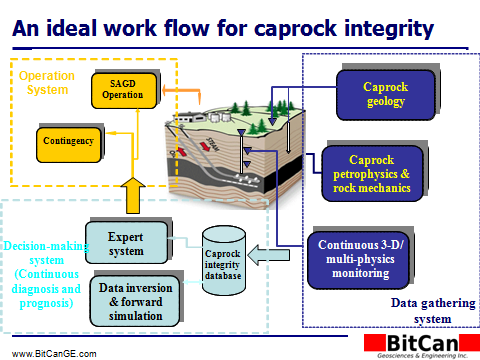
Understanding Caprock Integrity in Geological Carbon Storage
Definition and Role of Caprock in Carbon Dioxide (CO₂) Containment
Caprock refers to low-permeability geological formations that act as seals, preventing the upward migration of injected CO₂. These formations, typically composed of shale or mudstone, are critical to the containment function of geological carbon storage systems. Their effectiveness depends on mechanical strength, capillary entry pressure, and long-term geochemical stability.
Key Sealing Mechanisms: Capillary, Hydraulic, and Mechanical
Capillary sealing occurs when caprock pore throat sizes prevent CO₂ from entering due to high entry pressure. Hydraulic sealing depends on extremely low permeability, while mechanical sealing relies on the structural integrity of the formation under stress conditions. These mechanisms collectively determine whether CO₂ remains trapped beneath the caprock.
Importance of Caprock Integrity for Long-Term Storage Security
Long-term storage security requires that caprock remains intact over extended timescales. Failure in any sealing mechanism may result in leakage pathways, making caprock integrity assessment a fundamental requirement for CCS feasibility and regulatory approval.
Failure Mechanisms Affecting Caprock Integrity
Pressure-Induced Fracturing and Tensile Failure
Injection of CO₂ increases pore pressure within the reservoir, which can reduce effective stress and lead to tensile fracturing if the fracture gradient is exceeded. Advanced modeling workflows show that defining safe pressure limits is essential to avoid caprock failure.
Fault Reactivation and Shear Slip Risks
Pre-existing faults can become reactivated under elevated pore pressure, leading to shear slip and potential leakage pathways. Coupled hydro-mechanical simulations demonstrate how pressure diffusion can destabilize faults and alter permeability.
Geochemical Alteration and Mineral Dissolution Effects
CO₂ injection leads to acidified brine conditions that can dissolve minerals within the caprock, altering porosity and permeability. Chemo-mechanical coupling studies highlight how these reactions can weaken sealing capacity over time.
Role of Advanced Reservoir Simulation in Caprock Assessment
Integration of Multiphase Flow and Pressure Modeling
Reservoir simulation provides the foundation for predicting CO₂ plume migration and pressure evolution. Multiphase flow models capture the interaction between CO₂ and formation fluids, enabling assessment of pressure buildup beneath the caprock.
Coupling Reservoir Simulation with Geomechanics
Coupled flow–geomechanical models are essential for evaluating stress redistribution and deformation under injection conditions. These models simulate how pressure changes influence rock mechanics and potential failure.
Incorporating Reactive Transport Processes into Models
Reactive transport modeling integrates geochemical reactions into simulation workflows, allowing evaluation of long-term changes in caprock properties. Fully coupled models combining flow, geomechanics, and geochemistry provide the most comprehensive assessment of integrity.
Geological and Geomechanical Data Requirements
Stress Field Characterization and In-Situ Measurements
Accurate stress characterization is required to define safe injection pressures and evaluate fracture risk. This includes measurements of minimum horizontal stress and pore pressure.
Caprock Petrophysical and Mechanical Properties
Key properties include permeability, porosity, tensile strength, and Young’s modulus. These parameters directly influence sealing capacity and mechanical stability.
Fault Mapping and Structural Interpretation
Detailed structural mapping is necessary to identify potential leakage pathways and assess fault stability under injection conditions.
Static Modeling for Caprock Evaluation
Building High-Resolution Geological Models
Static models integrate seismic data, well logs, and core analysis to construct detailed representations of subsurface geology.
Characterizing Caprock Thickness and Continuity
Thickness and lateral continuity of caprock are critical factors influencing sealing effectiveness.
Identifying Structural Traps and Seal Geometry
Structural traps must be accurately defined to ensure CO₂ containment within the reservoir.
Dynamic Simulation of CO₂ Injection and Pressure Evolution
Modeling CO₂ Plume Migration Beneath Caprock
Simulation of plume migration helps predict the spatial distribution of CO₂ and its interaction with caprock.
Pressure Buildup and Dissipation in Reservoir Systems
Pressure evolution is a key factor in determining storage capacity and caprock stability. Pressure propagation often extends beyond the plume footprint.
Impact of Injection Rates on Caprock Stability
Higher injection rates can lead to rapid pressure buildup, increasing the risk of caprock failure.
Coupled Geomechanical Modeling Approaches
Stress-Strain Modeling Under CO₂ Injection Conditions
Geomechanical models simulate deformation of rock formations under changing stress conditions.
Fracture Gradient and Failure Envelope Analysis
Failure envelopes define the limits within which injection operations remain safe.
Simulation of Fault Slip and Induced Seismicity
Probabilistic modeling approaches are used to evaluate fault reactivation risks.
Reactive Transport Modeling for Caprock Integrity
CO₂–Brine–Rock Interaction Mechanisms
CO₂ dissolution in brine leads to chemical reactions that alter mineral composition.
Mineral Dissolution and Precipitation Effects
Dissolution can increase permeability, while precipitation may reduce it, affecting sealing behavior.
Long-Term Changes in Porosity and Permeability
These changes influence long-term storage performance and must be incorporated into simulation models.
Pressure Management Strategies to Protect Caprock
Defining Maximum Allowable Injection Pressure (MAIP)
MAIP is defined based on fracture pressure and geomechanical constraints to ensure safe operation.
Brine Extraction and Pressure Relief Techniques
Brine extraction can reduce pressure buildup and improve storage capacity.
Optimizing Injection Strategies for Pressure Control
Well placement and injection scheduling are optimized to manage pressure distribution.
Uncertainty Quantification and Risk Assessment
Probabilistic Modeling of Caprock Failure Risk
Uncertainty in geological and mechanical parameters is addressed using probabilistic approaches.
Sensitivity Analysis of Key Geological Parameters
Sensitivity analysis identifies parameters that most influence simulation outcomes.
Scenario-Based Simulation for Risk Mitigation
Multiple scenarios are evaluated to ensure robust design under varying conditions.
Monitoring and Verification of Caprock Integrity
Seismic Monitoring and Microseismic Detection
Seismic methods are used to detect subsurface changes and potential fracture development.
Pressure Surveillance and Well-Based Monitoring
Pressure monitoring provides real-time data for validating simulation predictions.
Geochemical Monitoring of Caprock Interactions
Chemical sampling helps detect changes in formation fluids and potential leakage.
Regulatory and Industry Standards for Caprock Integrity
CO₂ Storage Regulations and Compliance Requirements
Regulatory frameworks require demonstration of long-term containment and risk management.
Application of SRMS and DNV Recommended Practices
Standards such as SRMS and DNV guidelines provide structured approaches for evaluating storage performance.
Documentation for Permitting and Environmental Approval
Comprehensive technical documentation is required for regulatory approval.
Case Studies of Caprock Integrity Assessment Using Simulation
Field-Scale CCS Projects and Observed Caprock Behavior
Field studies provide valuable insights into caprock performance under real injection conditions.
Lessons from Injection-Induced Deformation and Pressure Effects
Observed deformation and pressure responses highlight the importance of integrated modeling.
Application of Coupled Modeling in Real-World Projects
Coupled simulation approaches have been successfully applied in CCS projects to evaluate integrity.
Common Challenges in Caprock Integrity Modeling
Uncertainty in Geological and Geomechanical Data
Limited data availability introduces uncertainty into models.
Limitations of Coupled Simulation Models
Coupled models are computationally intensive and require significant calibration.
Scaling Laboratory Results to Field Conditions
Laboratory experiments may not fully represent field-scale behavior.
Best Practices for Caprock Integrity Assessment
Integrated Multiphysics Modeling Workflows
Combining flow, geomechanics, and geochemistry provides comprehensive assessments.
Continuous Model Calibration with Monitoring Data
Models should be updated as new data becomes available.
Conservative Design Approaches for Risk Reduction
Conservative assumptions help ensure safety and regulatory compliance.
Frequently Asked Questions
What is caprock integrity in carbon storage projects?
It refers to the ability of the caprock to prevent upward migration of CO₂ and ensure long-term containment.
How does reservoir simulation help assess caprock integrity?
It predicts pressure, plume behavior, and stress changes that influence caprock stability.
What causes caprock failure during CO₂ injection?
Excessive pressure, fault reactivation, and geochemical weakening are key causes.
What is the role of geomechanical modeling in caprock assessment?
It evaluates stress changes, deformation, and failure risks.
How is maximum allowable injection pressure determined for caprock safety?
It is defined based on fracture pressure and geomechanical constraints.
Can geochemical reactions weaken caprock over time?
Yes, CO₂–brine interactions can alter mineral composition and reduce sealing capacity.
What monitoring techniques are used to detect caprock failure?
Seismic monitoring, pressure sensors, and geochemical sampling are commonly used.
How do faults influence caprock integrity in CCS projects?
Faults can act as leakage pathways if reactivated.
What data is required for accurate caprock integrity modeling?
Geological, petrophysical, geomechanical, and geochemical data are required.
What are the limitations of current caprock simulation models?
They include data uncertainty, computational complexity, and scaling challenges.
References
Adu-Gyamfi, B., et al. (2022). Chemo-mechanical impacts of CO₂ on reservoir-caprock systems.
https://pmc.ncbi.nlm.nih.gov/articles/PMC9338033/
AlDhuhoori, M., Belhaj, H., AlHameli, F., & Moncada, A. (2023). A simplified mathematical model for formation caprock integrity incorporating creep deformation: Implications for hydrogen underground storage. SPE Annual Technical Conference and Exhibition.
https://doi.org/10.2118/215125-MS
Alvarez, A., Mercado, D., & Salazar, V. (2023). Modeling caprock failure during injection in a CO₂ capture and storage project using a compositional/geochemical/geomechanical coupled numerical simulation. SPE Latin American and Caribbean Petroleum Engineering Conference.
https://doi.org/10.2118/213135-MS
Cappa, F., & Rutqvist, J. (2011). Modeling of coupled deformation and permeability evolution during fault reactivation induced by deep underground injection of CO₂. International Journal of Greenhouse Gas Control, 5(2), 336–346.
https://doi.org/10.1016/j.ijggc.2010.08.005
Chen, B. (2025). Caprock sealing for geologic CO₂ storage.
https://www.sciencedirect.com/science/article/pii/S1674775525001350
Espinoza, D. N., et al. (2017). CO₂ breakthrough and caprock sealing efficiency. International Journal of Greenhouse Gas Control.
https://www.sciencedirect.com/science/article/pii/S1750583617305601
Gasanzade, F., et al. (2025). A workflow for estimating injection pressure limits for CO₂ storage. International Journal of Greenhouse Gas Control, 134, 104232.
https://doi.org/10.1016/j.ijggc.2025.104232
Hawez, H. K., Bakir, H., Jamal, K., Kakakhan, M., Hussein, K., & Omar, M. (2025). Numerical investigation of CO₂ injection effects on shale caprock integrity: A case study of Opalinus Clay. Gases, 5(3), 15.
https://doi.org/10.3390/gases5030015
Hwang, J., Kang, S.-G., & Park, Y.-G. (2010). Technical review on risk assessment methodology for carbon marine geological storage systems. Journal of the Korean Society for Marine Environment & Energy, 13.
Hwang, J., et al. (2023). Probabilistic evaluation of geomechanical risks in CO₂ storage: An exploration of caprock integrity metrics using a multilaminate model. Energies, 16(19), 6954.
https://doi.org/10.3390/en16196954
Ji, L. (2018). Coupled flow simulation and geomechanical modeling on CO₂ storage in a saline aquifer. Earth Sciences, 7(5), 216–226.
https://doi.org/10.11648/j.earth.20180705.13
Karimnezhad, M., Jalalifar, H., & Kamari, M. (2014). Investigation of caprock integrity for CO₂ sequestration in an oil reservoir using a numerical method. Journal of Natural Gas Science and Engineering, 21, 1127–1137.
https://doi.org/10.1016/j.jngse.2014.10.031
Paluszny, A., Graham, C. C., Daniels, K. A., Tsaparli, V., Xenias, D., Salimzadeh, S., Whitmarsh, L., Harrington, J. F., & Zimmerman, R. W. (2020). Caprock integrity and public perception studies of carbon storage in depleted hydrocarbon reservoirs. International Journal of Greenhouse Gas Control, 98, 103057.
https://doi.org/10.1016/j.ijggc.2020.103057
Rohmer, J., & Bouc, O. (2009). Addressing uncertainties in cap rock integrity assessment through a response surface methodology. Energy Procedia, 1, 2879–2886.
https://doi.org/10.1016/j.egypro.2009.02.062
Rutqvist, J. (2012). The geomechanics of CO₂ storage in deep sedimentary formations. Geotechnical and Geological Engineering, 30(3), 525–551.
https://doi.org/10.1007/s10706-011-9491-0
Shukla, R., Ranjith, P. G., Choi, S. K., & Haque, A. (2010). CO₂ storage in geological formations: A review of trapping mechanisms and caprock integrity. Applied Energy.
https://www.sciencedirect.com/science/article/pii/S0016236110002218
Soltanzadeh, H., & Hawkes, C. (2012). Semi-analytical models for stress change and fault stability analysis in CO₂ storage. International Journal of Greenhouse Gas Control.
https://www.sciencedirect.com/science/article/pii/S1750583611001988
Trujillo, N., Rose-Coss, D., Heath, J. E., Dewers, T. A., Ampomah, W., Mozley, P. S., & Cather, M. (2021). Multiscale assessment of caprock integrity for geologic carbon storage in the Farnsworth Unit, Texas, USA. Energies, 14(18), 5824.
https://doi.org/10.3390/en14185824
Van der Veer, E. F., Waldmann, S., & Fokker, P. A. (2015). A coupled geochemical-transport-geomechanical model to address caprock integrity during long-term CO₂ storage. US Rock Mechanics/Geomechanics Symposium.
https://www.researchgate.net/publication/279525923
Xiong, J., Deisman, N., Chalaturnyk, R., & Huang, X. (2012). Reservoir-geomechanical analysis for caprock integrity evaluation during oilsand development. Disaster Advances, 5, 1713–1717.
Zappone, A., et al. (2020). Fault sealing and caprock integrity for CO₂ storage. Solid Earth, 12, 319–334.
https://se.copernicus.org/articles/12/319/2021/