
Understanding Model Validation in Geological Carbon Storage
Definition of Model Validation in CCS Context
Model validation in carbon capture and storage (CCS) refers to the systematic process of demonstrating that a numerical model can reliably predict the behavior of injected carbon dioxide (CO₂) within geological formations over extended timescales. This includes verifying that model outputs are consistent with physical laws, geological data, and observed field behavior. Validation extends beyond code correctness to ensure that the model is fit-for-purpose in predicting plume migration, pressure evolution, and trapping mechanisms.
Read also:
Why Long-Term Containment Requires Rigorous Validation
Unlike conventional reservoir engineering problems, CCS requires predictions over hundreds to thousands of years. Direct observation is impossible, so validation must rely on indirect methods such as benchmarking, monitoring data, and natural analogues. Long-term containment security depends on accurately modeling multiphase flow, geochemical reactions, and geomechanical responses.
Differences Between Model Verification and Validation
Verification ensures that numerical algorithms are implemented correctly, while validation assesses whether the model accurately represents real-world processes. Industry frameworks such as DNV-RP-G101 emphasize the need for both steps to ensure simulation credibility.
Key Objectives of Model Validation for CO₂ Storage Security
Ensuring Predictive Accuracy Over Long Timeframes
Validated models must demonstrate stability and predictive reliability across extended simulation periods, capturing long-term trapping mechanisms such as residual and solubility.
Demonstrating Geological Plausibility of Simulation Results
Simulation outputs must align with known geological behavior, including pressure propagation and plume migration patterns observed in subsurface systems.
Supporting Regulatory and Investment Decision-Making
Validated models form the basis for regulatory approval and financial investment by demonstrating that storage sites can securely contain CO₂ over geological timescales.
International Standards Governing CCS Model Validation
Overview of ISO 27914 Requirements for Geological Storage
The ISO 27914:2017 standard provides the global framework for the safe design and operation of storage sites. It establishes requirements and recommendations for the geological storage of carbon dioxide (CO₂) streams. Its primary goal is to promote safe, long-term containment of
while minimizing risks to the environment and human health. ISO 27914 defines requirements for site characterization, risk management, and model validation, emphasizing iterative calibration and monitoring integration.
DNV Recommended Practices for Model Verification and Validation
DNV-RP-G101 provides detailed guidelines for model verification, validation, and uncertainty management, including requirements for reproducibility and sensitivity analysis. It is the recommended practice, which offers a granular workflow for verifying that simulation results are reproducible and defensible to third-party auditors
Role of SRMS in Classifying Storage Resources and Uncertainty
The Storage Resources Management System (SRMS) standardizes classification of storage capacity and resources, ensuring that simulation outputs are aligned with probabilistic confidence levels. The SRMS helps classify storage resources into capacity based on technical maturity and the level of validated modeling completed.
Benchmarking and Cross-Model Validation Approaches
Purpose of Comparative Simulation Projects (e.g., SPE11)
Benchmarking initiatives such as the SPE Comparative Solution Project evaluate how different simulators handle complex CO₂ storage processes, including convective mixing and plume evolution. The 11th SPE Comparative Solution Project (SPE11) is the current industry benchmark. It specifically tests how simulators handle the interplay of plume migration and convective mixing in saline aquifers
Cross-Code Verification Between Reservoir Simulators
A cornerstone of validation is Cross-Code Verification. If two independent simulators (e.g., CMG-GEM and TOUGH2) yield identical results for a complex injection scenario, the numerical stability is considered validated. Cross-model validation ensures that independent simulation tools produce consistent results under identical conditions, increasing confidence in predictions.
Validating Numerical Methods and Solver Accuracy
Numerical stability and convergence behavior are critical validation components, particularly for multiphase reactive transport simulations.
History Matching and Calibration in CCS Model Validation
Using Historical Data to Constrain Model Parameters
History matching aligns model predictions with observed data such as pressure and production trends, reducing uncertainty.
Matching Pressure, Plume Migration, and Saturation Profiles
Field data from CCS projects demonstrate the importance of matching surface deformation and pressure responses to validate models. For example, the In Salah project where surface heave data (InSAR) revealed geomechanical behaviors that were initially unpredicted, forcing an iterative validation and recalibration of the coupled models
Iterative Calibration for Improved Predictive Reliability
Model calibration is an iterative process that refines parameters to improve predictive accuracy over time.
Integration of Monitoring Data into Model Validation
Role of Measurement, Monitoring, and Verification (MMV)
Measurement, Monitoring, and Verification (MMV) data provide the real-world feedback loop required for validation. By matching the predicted CO₂ plume behavior with 4D seismic and downhole pressure data, operators can calibrate their models for better long-term reliability. MMV frameworks integrate observational data into models to validate predictions and update simulations dynamically.
Using Seismic, Pressure, and Geochemical Data for Validation
Seismic imaging, pressure monitoring, and geochemical sampling provide critical datasets for validating plume migration and storage behavior.
Updating Models with Real-Time Field Observations
Continuous model updating ensures alignment between predictions and actual reservoir behavior.
Natural Analogues as Validation Tools for Long-Term Storage
Using Natural CO₂ Reservoirs to Validate Containment Assumptions
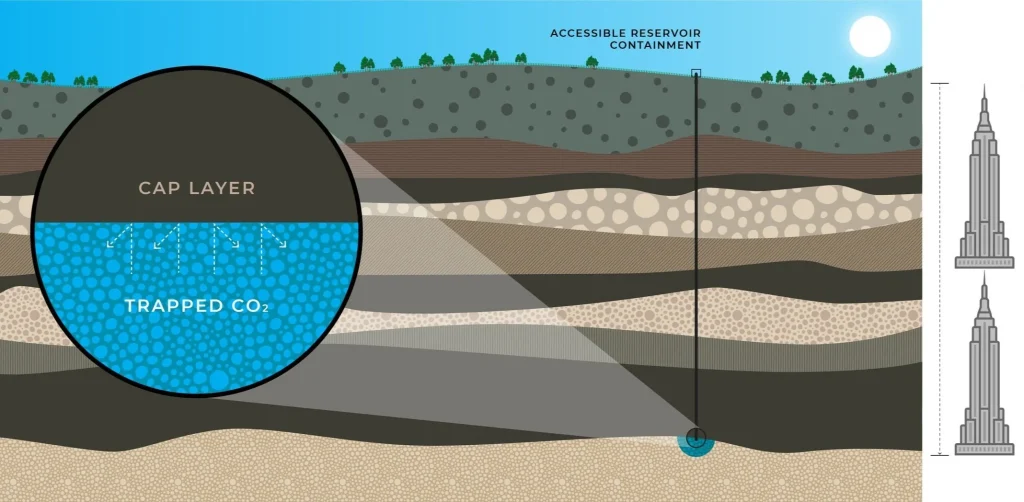
Since human-made CCS projects are only a few decades old, natural analogues can serve as a guide. Natural Analogues are geological reservoirs that have trapped CO₂ for millions of years. These systems validate our assumptions about capillary entry pressure and caprock endurance over geological timescales. Natural CO₂ accumulations demonstrate that geological formations can retain CO₂ for millions of years.
Lessons from Geological Systems with Million-Year Containment
These analogues provide validation for capillary sealing and long-term trapping mechanisms.
Limitations of Analogue-Based Validation
Differences in geological conditions limit direct applicability to engineered storage systems.
Coupled Multiphysics Validation Frameworks
Validation must be multiphysics-integrated, not just about fluid flow. These includes:
- Geomechanics: Validating stress-strain behavior to prevent fault reactivation.
- Geochemistry: Using advanced modeling to predict long-term mineral precipitation.
Validation of Multiphase Flow Models
Accurate modeling of CO₂-brine interactions is essential for predicting plume migration.
Coupling Geomechanical Models with Reservoir Simulation
Coupled simulations assess deformation and fault reactivation risks.
Integrating Reactive Transport and Geochemical Processes
Reactive transport models simulate mineral trapping and long-term geochemical evolution.
Uncertainty Quantification in Model Validation
Given the data gaps in the deep subsurface, validation must be probabilistic. Monte Carlo simulations and Sensitivity Analysis are used to identify the Key Performance Indicators (KPIs) of storage security, such as fracture pressure or spill-point geometry.
Identifying Sources of Uncertainty in CCS Models
Uncertainty arises from geological variability, parameter estimation, and modeling assumptions.
Probabilistic Modeling and Monte Carlo Simulation
Probabilistic frameworks quantify uncertainty and define confidence ranges.
Sensitivity Analysis for Key Geological and Operational Parameters
Sensitivity analysis identifies critical parameters influencing model outcomes.
Risk-Based Validation for Long-Term Containment
Linking Model Outputs to Risk Assessment Frameworks
Validated models support risk assessment by quantifying potential failure scenarios.
Evaluating Leakage Pathways and Caprock Integrity
Faults, fractures, and well integrity are key risk pathways evaluated in simulations.
Scenario-Based Validation for Worst-Case Conditions
Stress-testing models under extreme scenarios ensures robustness.
Validation of Pressure and Plume Migration Predictions
Pressure Footprint Validation Beyond the CO₂ Plume
Pressure propagation extends beyond the plume and must be accurately modeled.
Verifying Plume Migration and Trapping Mechanisms
Validation ensures correct representation of structural, residual, and solubility trapping.
Assessing Long-Term Stabilization of Injected CO₂
Long-term simulations evaluate the transition to stable trapping mechanisms.
Software and Numerical Validation Standards
Validation of Simulation Algorithms and Numerical Stability
Numerical accuracy is verified through convergence testing and benchmarking.
Ensuring Consistency Across Different Modeling Platforms
Cross-platform consistency enhances confidence in simulation results.
Role of High-Performance Computing in Large-Scale Validation
Advanced computing enables large-scale, high-resolution simulations.
Regulatory Requirements for Model Validation in CCS Projects
Documentation Standards for Model Validation Reports
Regulators require transparent documentation of assumptions, inputs, and methodologies.
Regulatory Expectations for Long-Term Containment Demonstration
Validation must demonstrate containment over regulatory timeframes.
Third-Party Review and Independent Verification
Independent reviews enhance credibility and reduce bias.
Challenges in Validating Long-Term CO₂ Containment Models
Limitations of Predicting Thousand-Year Timescales
Long-term predictions are inherently uncertain due to limited data.
Data Gaps and Geological Uncertainty
Incomplete subsurface data introduces uncertainty in model inputs.
Computational Constraints in Multiphysics Modeling
Coupled simulations require significant computational resources.
Best Practices for Model Validation in CCS Projects
Combining Benchmarking, Calibration, and Monitoring
Integrated validation approaches provide the most robust results.
Maintaining Model Transparency and Reproducibility
Transparent workflows ensure credibility and auditability.
Continuous Model Updating Throughout Project Lifecycle
Models should evolve with new data and operational insights.
Frequently Asked Questions
What is model validation in carbon storage projects?
It is the process of confirming that simulation models accurately represent CO₂ behavior in geological formations.
How is long-term CO₂ containment validated without direct observation?
Through benchmarking, monitoring data integration, probabilistic modeling, and natural analogues.
What standards govern model validation for CCS projects?
ISO 27914, DNV-RP-G101, and SRMS are key standards.
Why is history matching important in CCS model validation?
It ensures that models accurately reproduce observed reservoir behavior.
How do benchmarking studies improve simulation reliability?
They compare different simulators to verify consistency and accuracy.
What role do natural analogues play in validating CO₂ storage models?
They provide evidence of long-term containment in natural systems.
How is uncertainty handled in long-term containment modeling?
Through probabilistic simulations and sensitivity analysis.
What monitoring data is used to validate CCS simulation models?
Seismic data, pressure measurements, and geochemical observations.
How do regulators assess the credibility of storage models?
By reviewing validation workflows, uncertainty analysis, and compliance with standards.
What are the biggest challenges in validating long-term CO₂ containment?
Uncertainty, limited data, and the difficulty of predicting long-term geological processes.
References
Abd, A. S., & Abushaikha, A. (2026). Assessing the efficiency of long-term CO₂ geological storage using an advanced multiphase compositional simulator. Petroleum. https://doi.org/10.1016/j.petlm.2026.02.002
Cappa, F., & Rutqvist, J. (2011). Modeling of coupled deformation and permeability evolution during fault reactivation induced by deep underground injection of CO₂. International Journal of Greenhouse Gas Control, 5(2), 336–346. https://doi.org/10.1016/j.ijggc.2010.08.005
Celia, M. A., Bachu, S., Nordbotten, J. M., & Bandilla, K. W. (2015). Status of CO₂ storage in deep saline aquifers with emphasis on modeling approaches and simulations. Water Resources Research, 51(9), 6846–6892. https://doi.org/10.1002/2015WR017609
CSA Group. (2022). Z741-12: Geological storage of carbon dioxide. https://www.csagroup.org/store/product/Z741-12/
DNV. (2024). Geological storage of carbon dioxide (DNV-RP-G101). https://www.dnv.com/energy/standards-guidelines/dnv-rp-j203-geological-storage-of-carbon-dioxide/
Hurtado, A., Eguilior, S., & Recreo, F. (2014). Methodological development of a probabilistic model for CO₂ geological storage safety assessment. International Journal of Energy and Environmental Engineering, 5, 84. https://doi.org/10.1007/s40095-014-0084-6
International Organization for Standardization (ISO). (2017). ISO 27914:2017 Carbon dioxide capture, transportation and geological storage — Geological storage. https://www.iso.org/standard/64148.html
Jenkins, C. R., Cook, P. J., Ennis-King, J., Underschultz, J., Boreham, C., Dance, T., de Caritat, P., Etheridge, D. M., Freifeld, B. M., Hortle, A., Kirste, D., Paterson, L., Pevzner, R., Schacht, U., Sharma, S., Stalker, L., & Urosevic, M. (2012). Safe storage and effective monitoring of CO₂ in depleted gas fields. Proceedings of the National Academy of Sciences, 109(35). https://doi.org/10.1073/pnas.1107255108
Jiang, X. (2011). A review of physical modelling and numerical simulation of long-term geological storage of CO₂. Applied Energy, 88(11), 3557–3566. https://doi.org/10.1016/j.apenergy.2011.05.004
National Energy Technology Laboratory (NETL). (2017). Best practices: Risk management and simulation for geologic storage projects. https://www.netl.doe.gov/sites/default/files/2018-10/BPM_RiskAnalysisSimulation.pdf
Nazarian, B., Held, R., Høier, L., & Ringrose, P. (2013). Reservoir management of CO₂ injection: Pressure control and capacity enhancement. Energy Procedia. https://doi.org/10.1016/j.egypro.2013.06.292
Pearce, J. M., Holloway, S., Wacker, H., Nelis, M. K., Rochelle, C., & Bateman, K. (1996). Natural occurrences as analogues for the geological disposal of carbon dioxide. Energy Conversion and Management, 37(6–8), 1123–1128. https://doi.org/10.1016/0196-8904(95)00307-X
Ringrose, P. S., & Bentley, M. E. (2021). Reservoir model design: A guide to building and using reservoir models (2nd ed.). Springer. https://link.springer.com/book/10.1007/978-3-030-33113-9
Rohmer, J., & Bouc, O. (2009). Addressing uncertainties in cap rock integrity assessment through a response surface methodology. Energy Procedia, 1, 2879–2886. https://doi.org/10.1016/j.egypro.2009.02.062
Rutqvist, J. (2012). The geomechanics of CO₂ storage in deep sedimentary formations. Geotechnical and Geological Engineering, 30(3), 525–551. https://doi.org/10.1007/s10706-011-9491-0
Society of Petroleum Engineers (SPE). (2017). CO₂ storage resources management system (SRMS). https://www.spe.org/media/filer_public/3c/21/3c21b6b8-b6fd-4fd5-aa2f-d8551136b085/211021_srms_guidelines.pdf
Society of Petroleum Engineers (SPE). (2025). Results from the 11th SPE comparative solution project (SPE11): Benchmarking simulation tools for geological CO₂ storage. International Journal of Greenhouse Gas Control, 134, 104519. https://doi.org/10.1016/j.ijggc.2025.104519
Sun, W., Liu, W., Ren, S., Lin, G., Wang, C., & Jiang, X. (2025). CO₂ geological storage site selection and long-term potential assessment framework based on TOUGH2/ECO2N. PLOS ONE, 20(4), e0321715. https://doi.org/10.1371/journal.pone.0321715
Sui, D., Wang, X., Zhan, M., Sadeghpour, F., Torkashvand, M., Nasirzadeh, E., & Ostadhassan, M. (2026). CO₂ storage capacity estimation in underground geological sites using innovative data-driven techniques. Energy. https://doi.org/10.1016/j.energy.2026.140492
Van der Veer, E. F., Waldmann, S., & Fokker, P. A. (2015). A coupled geochemical-transport-geomechanical model to address caprock integrity during long-term CO₂ storage. US Rock Mechanics/Geomechanics Symposium. https://www.researchgate.net/publication/279525923
White, J. A., Chiaramonte, L., Ezzedine, S., et al. (2014). Geomechanical behavior of the In Salah CO₂ storage project: Lessons learned from coupled simulation. International Journal of Greenhouse Gas Control, 28, 326–342. https://doi.org/10.1016/j.egypro.2013.06.551
Zhang, Y., et al. (2025). Advanced geochemical modeling of CO₂ storage systems. ACS Omega. https://doi.org/10.1021/acsomega.5c08518