
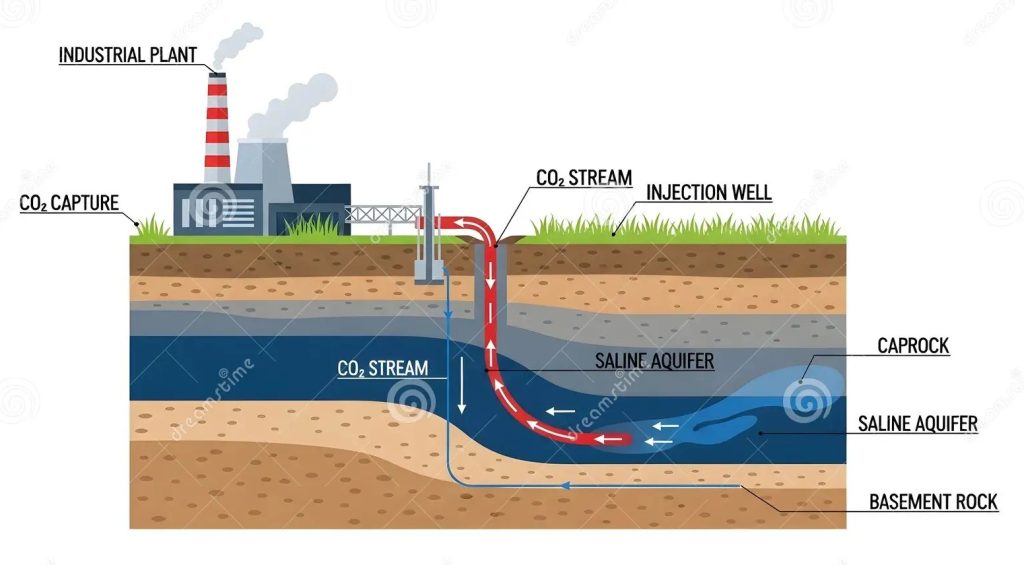
Saline Aquifers as Geological Storage Formations for CO2
Deep saline aquifers are widely considered one of the most promising geological formations for long-term carbon dioxide storage. These formations consist of porous sedimentary rocks saturated with highly saline formation water that is not suitable for human consumption or agricultural use. Because saline aquifers are widespread in sedimentary basins and often possess large storage volumes, they provide significant potential for large-scale CO2 sequestration.
In carbon capture and storage (CCS) projects, captured carbon dioxide is compressed and injected into these deep formations where it can be contained through multiple trapping mechanisms, including structural trapping beneath caprock seals, residual trapping within pore spaces, dissolution into formation brine, and long-term mineralization. The technical feasibility of a saline aquifer storage site therefore depends on careful evaluation of reservoir properties, caprock integrity, injection behavior, and long-term containment performance.
Read more:
What Defines an Investment-Grade CO2 Storage Feasibility Study
Technical Due Diligence Requirements for CCS Project Financing
An investment-grade feasibility study for saline aquifer CO2 storage is designed to provide sufficient technical and economic certainty for project developers, financiers, and regulators to make informed decisions regarding CCS project deployment. An investment-grade study must provide the technical certainty required for “bankability.” This means moving beyond theoretical estimates and using the Storage Resources Management System (SRMS) framework to classify resources into “capacity” based on commercial maturity.
Technical due diligence typically includes detailed geological characterization, reservoir modeling, geomechanical assessment, risk analysis, and monitoring program design. These analyses collectively demonstrate storage capacity, injection performance, and containment reliability, which are critical considerations for infrastructure financing and project permitting.
Differences Between Screening Studies and Investment-Grade Assessments
Early-stage screening studies are used to identify potential storage sites within sedimentary basins based on limited geological data. These studies often rely on regional datasets and simplified modeling approaches to estimate storage potential.
In contrast, investment-grade feasibility assessments require high-resolution 3D geological models and calibrated simulations to reduce operational uncertainty to levels acceptable for a Final Investment Decision (FID). High-resolution geological models, calibrated reservoir simulations, and risk assessments are used to evaluate site performance under realistic operational scenarios. The goal is to reduce geological and operational uncertainties to levels acceptable for project financing and regulatory approval.
Key Metrics Investors Evaluate in Carbon Storage Projects
Investors and project developers typically evaluate several technical metrics when assessing the viability of a CO2 storage project. These include estimated storage capacity, sustainable injection rates, reservoir pressure management, and long-term containment reliability.
Additional considerations include reservoir connectivity, caprock integrity, proximity to CO2 sources, and infrastructure availability. Together, these factors determine whether a saline aquifer storage site can support commercial-scale CCS deployment.
Site Screening and Basin-Level Assessment
Identifying Prospective Sedimentary Basins for CO2 Storage
The feasibility assessment process begins with basin-level screening to identify sedimentary basins with suitable geological characteristics for CO2 storage. Key factors include basin depth, reservoir thickness, regional structural stability, and the presence of effective caprock formations.
Basins containing thick sequences of porous sedimentary rocks overlain by impermeable seals are typically considered strong candidates for saline aquifer storage.
Evaluating Regional Geological Storage Capacity
Regional storage capacity estimates are developed using geological datasets such as basin stratigraphy, reservoir thickness, and porosity distribution. These analyses provide an initial estimate of the volume of CO2 that may be stored within a given formation. Storage capacity estimates are refined as more detailed reservoir characterization and modeling studies are performed.
Assessing Infrastructure Access and CO2 Transport Proximity
Infrastructure considerations are also critical during basin screening. Feasible storage sites should ideally be located near major CO2 emission sources or existing transportation infrastructure such as pipelines. Transport distance and infrastructure availability directly influence project economics and deployment timelines.
Geological Characterization of Saline Aquifer Storage Formations
Stratigraphic Analysis and Reservoir Architecture
Detailed geological characterization is required to understand the stratigraphic architecture of potential storage formations. Stratigraphic analysis identifies reservoir units, sealing formations, and structural features that influence CO2 migration and containment.
Understanding reservoir architecture helps determine the spatial distribution of storage capacity and injection performance.
Reservoir Properties: Porosity, Permeability, and Thickness
Reservoir properties play a critical role in determining storage performance. Porosity controls the storage volume available within the rock matrix, while permeability governs the ability of CO2 to move through the formation.
Reservoir thickness and lateral extent also influence storage capacity and injection efficiency.
Caprock Integrity and Seal Capacity Evaluation
Caprock formations act as impermeable barriers that prevent upward migration of injected CO2. Evaluating seal capacity requires analysis of caprock permeability, thickness, and mechanical properties.
Fault systems and fractures must also be assessed to determine whether they could serve as potential leakage pathways.
Static Geological Modeling for CO2 Storage Systems
Building Three-Dimensional Geological Models
Three-dimensional geological models integrate geological and geophysical data to represent the spatial distribution of reservoir properties within the storage formation. These models provide the structural framework for reservoir simulation studies.
Integrating Seismic Data, Well Logs, and Core Analysis
High-quality geological models rely on the integration of multiple data sources. Seismic surveys provide structural imaging of subsurface formations, while well logs and core samples provide direct measurements of reservoir properties.
Combining these datasets improves model accuracy and reduces uncertainty in storage capacity estimates.
Characterizing Reservoir Heterogeneity and Structural Traps
Reservoir heterogeneity can significantly influence CO2 plume migration and pressure distribution. Geological models must therefore capture variations in permeability, porosity, and lithology across the storage formation.
Structural traps such as anticlines and fault-bounded compartments may also influence CO2 distribution.
Dynamic Reservoir Simulation of CO2 Injection
Multiphase Flow Modeling of CO2 and Formation Brine
Reservoir simulation models are used to predict how injected CO2 interacts with formation fluids and migrates through the reservoir. These models simulate multiphase flow behavior between supercritical CO2 and formation brine.
Predicting CO2 Plume Migration and Pressure Evolution
Dynamic simulations track the movement of the CO2 plume and evaluate pressure buildup during injection operations. Understanding pressure evolution is essential for preventing caprock failure and ensuring reservoir stability.
Evaluating Injection Rates and Storage Capacity
Simulation results are used to determine sustainable injection rates and evaluate the effective storage capacity of the formation under operational constraints.
Geomechanical and Caprock Integrity Analysis
Stress Regime Evaluation and Fracture Pressure Limits
Geomechanical modeling evaluates in-situ stress conditions within the storage formation and surrounding rock units. These analyses determine fracture pressure limits that must not be exceeded during injection operations.
Caprock Failure Risk Assessment
Caprock failure risk assessments examine whether injection-induced pressure changes could compromise seal integrity.
Modeling Induced Seismicity Risks from CO2 Injection
Injection operations can alter subsurface stress fields, potentially triggering small seismic events. Geomechanical modeling helps evaluate these risks and inform injection strategies.
Geochemical and Fluid Interaction Modeling
CO2–Brine–Rock Reaction Mechanisms
Geochemical modeling evaluates chemical reactions between injected CO2, formation brine, and reservoir rocks.
Mineralization Processes in Saline Aquifers
Over long timescales, dissolved CO2 can react with minerals within the reservoir to form stable carbonate minerals.
Long-Term Impacts of Geochemical Reactions on Storage Integrity
Geochemical reactions may influence porosity, permeability, and long-term storage stability.
Risk Assessment and Uncertainty Quantification
Probabilistic Modeling of Storage Performance
Probabilistic modeling techniques help quantify uncertainties associated with reservoir properties and operational conditions.
Evaluating Leakage Pathways and Fault Risks
Potential leakage pathways such as faults, fractures, or abandoned wells must be identified and evaluated.
Sensitivity Analysis for Reservoir and Operational Parameters
Sensitivity analyses determine which reservoir parameters most strongly influence storage performance.
Monitoring, Measurement, and Verification (MMV) Planning
Designing Subsurface Monitoring Programs
Monitoring systems track reservoir pressure, plume migration, and environmental impacts.
Seismic Monitoring and Pressure Surveillance
Time-lapse seismic surveys and pressure monitoring systems are commonly used to track subsurface CO2 movement.
Groundwater Monitoring and Environmental Safeguards
Monitoring programs also assess potential impacts on groundwater resources.
Regulatory Compliance and Permitting Considerations
CO2 Injection Well Regulations and Permitting Frameworks
CCS projects must comply with regulatory frameworks governing underground injection operations.
Environmental Impact Assessments for CCS Projects
Environmental impact assessments evaluate potential environmental risks associated with CO2 storage operations.
Documentation Requirements for Regulatory Approval
Technical documentation supporting reservoir modeling, risk analysis, and monitoring plans is required for regulatory approval.
Economic and Commercial Evaluation of CO2 Storage Projects
Storage Capacity Estimates and Economic Viability
Economic viability depends on storage capacity, injection efficiency, and infrastructure costs.
Cost Modeling for CO2 Injection and Monitoring Systems
Cost models account for drilling, injection infrastructure, monitoring technologies, and long-term site stewardship.
Investment Risk Evaluation for CCS Infrastructure
Investors assess geological, operational, and regulatory risks when evaluating CCS projects.
Deliverables of an Investment-Grade Storage Feasibility Study
Reservoir Modeling Reports and Storage Capacity Estimates
Detailed reservoir modeling reports provide technical documentation supporting storage capacity estimates.
Risk Assessment and Monitoring Plans
Risk assessments and monitoring strategies demonstrate long-term storage security.
Technical Documentation for Project Financing
Investment-grade studies provide technical documentation required for project financing and regulatory approval.
Frequently Asked Questions
What is an investment-grade saline aquifer CO2 storage feasibility study?
An investment-grade feasibility study is a detailed technical and economic assessment designed to determine whether a saline aquifer can safely and economically support large-scale CO2 storage operations.
What geological factors determine whether a saline aquifer is suitable for carbon storage?
Key factors include reservoir depth, porosity, permeability, thickness, caprock integrity, structural stability, and regional pressure conditions.
How is storage capacity estimated for deep saline aquifers?
Storage capacity estimates are developed using geological data, reservoir modeling, and simulation studies that evaluate the volume of pore space available for CO2 storage.
What modeling techniques are used in CO2 storage feasibility studies?
Common techniques include geological modeling, multiphase reservoir simulation, geomechanical modeling, and geochemical reaction modeling.
Why is caprock integrity critical for geological carbon storage projects?
Caprock formations act as seals that prevent upward migration of injected CO2, ensuring long-term containment within the storage formation.
What risks are evaluated in saline aquifer CO2 storage feasibility studies?
Risks include leakage pathways, caprock failure, pressure buildup, induced seismicity, and environmental impacts.
What monitoring technologies are used to verify CO2 storage performance?
Monitoring systems typically include seismic imaging, pressure monitoring, groundwater sampling, and geochemical analysis.
How do regulators evaluate saline aquifer carbon storage projects?
Regulators evaluate geological characterization data, reservoir modeling results, risk assessments, and monitoring plans to ensure safe and reliable storage.
What data is required to develop an investment-grade CCS feasibility study?
Required datasets typically include seismic surveys, well logs, core samples, reservoir property measurements, and regional geological data.
References
Bachu, S. (2008). CO2 storage in geological media: Role, means, status and barriers to deployment. Progress in Energy and Combustion Science, 34(2), 254–273. https://doi.org/10.1016/j.pecs.2007.10.001
Bachu, S., Bonijoly, D., Bradshaw, J., Burruss, R., Holloway, S., Christensen, N. P., & Mathiassen, O. M. (2007). CO2 storage capacity estimation: Methodology and gaps. International Journal of Greenhouse Gas Control, 1(4), 430–443. https://doi.org/10.1016/S1750-5836(07)00014-4
Celia, M. A., Bachu, S., Nordbotten, J. M., & Bandilla, K. W. (2015). Status of CO2 storage in deep saline aquifers with emphasis on modeling approaches and simulations. Water Resources Research, 51(9), 6846–6892. https://doi.org/10.1002/2015WR017609
DNV. (2024). Geological storage of carbon dioxide (DNV-RP-G101). https://www.dnv.com/rules-standards/dnv-rp-g101-geological-storage-of-carbon-dioxide/
Global CCS Institute. (n.d.). Global status of CCS report. https://www.globalccsinstitute.com/resources/global-status-report/
Helle, K., Tarigan, S., Røneid, S., & Sriskandarajah, T. (2011). DNV Recommended Practice: Design and operation of CO2 pipelines. Energy Procedia, 4, 3032–3039. https://doi.org/10.1016/j.egypro.2011.02.214
International Energy Agency. (n.d.). Carbon capture, utilisation and storage. https://www.iea.org/reports/carbon-capture-utilisation-and-storage
Intergovernmental Panel on Climate Change. (2005). IPCC special report on carbon dioxide capture and storage. Prepared by Working Group III. Cambridge University Press. https://www.ipcc.ch/report/carbon-dioxide-capture-and-storage/
Jenkins, C. R., Cook, P. J., Ennis-King, J., Laudal, T., & Sharma, S. (2012). Safe storage and effective monitoring of CO2 in depleted gas fields. Proceedings of the National Academy of Sciences, 109(35), E2309–E2318. https://doi.org/10.1073/pnas.1107255108
Oldenburg, C. M. (2008). Screening and ranking framework for geologic CO2 storage site selection on the basis of health, safety, and environmental risk. Environmental Geology, 54(8), 1687–1694. https://doi.org/10.1007/s00254-007-0945-z
Ringrose, P. S., & Bentley, M. E. (2021). Reservoir model design: A guide to building and using reservoir models (2nd ed.). Springer. https://link.springer.com/book/10.1007/978-3-030-33113-9
Society of Petroleum Engineers. (2017). CO2 storage resources management system (SRMS). https://www.spe.org/en/industry/reserves/storage-resources-management-system/
Zoback, M. D., & Gorelick, S. M. (2012). Earthquake triggering and large-scale geologic storage of carbon dioxide. Proceedings of the National Academy of Sciences, 109(26), 10164–10168. https://doi.org/10.1073/pnas.1202473109