
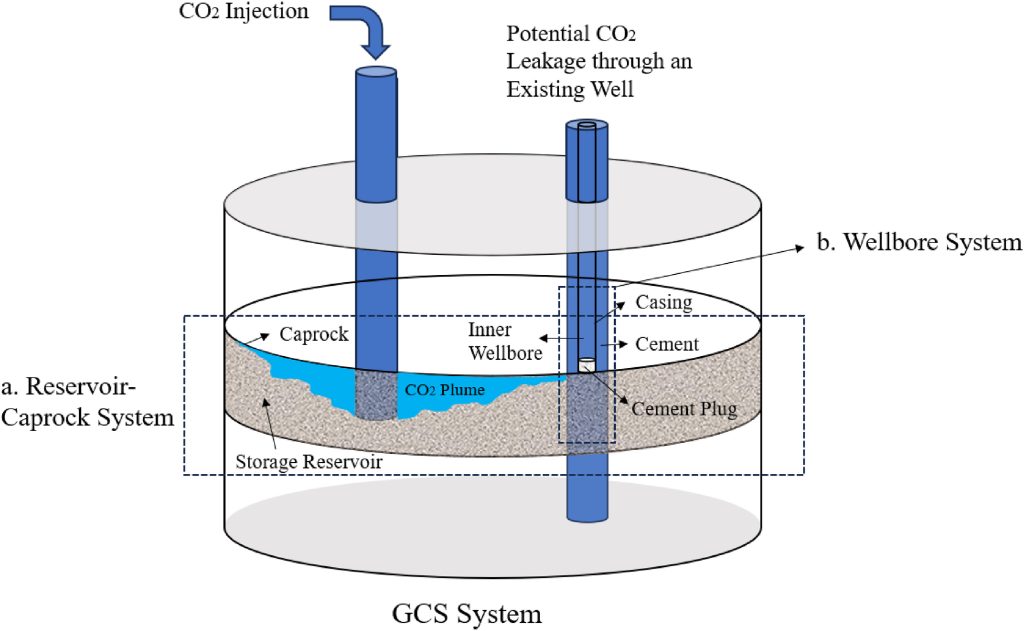
Fundamentals of Pressure Behavior in CO₂ Injection Systems
Reservoir Pressure Dynamics During CO₂ Injection
Injection of CO₂ into subsurface formations increases pore pressure as fluid mass accumulates within the reservoir. Unlike hydrocarbon production, which reduces pressure, CO₂ injection introduces a sustained pressure buildup that propagates outward from the injection well. This pressure evolution governs injectivity, plume migration, and long-term storage performance. Analytical and numerical studies show that pressure propagation can extend far beyond the CO₂ plume itself, forming a large “pressure footprint” that must be managed at the basin scale.
Read also:
Mechanisms of Pressure Build-Up in Confined Aquifers
In confined or semi-closed saline aquifers, pressure buildup occurs because displaced brine has limited pathways for migration. The lack of pressure dissipation leads to rapid pressure accumulation, especially under high injection rates. Modeling of CO₂–brine systems demonstrates that fluid displacement and compressibility effects are primary drivers of overpressure in such environments.
Impact of Injection Rate and Boundary Conditions on Pressure Evolution
Injection rate, reservoir compressibility, and boundary conditions strongly influence pressure behavior. High injection rates and closed boundaries lead to faster pressure buildup, while open boundaries allow pressure dissipation. Statistical and simulation-based studies confirm that permeability, compressibility, and injection strategy are key parameters controlling pressure evolution.
Why Pressure Management Is Critical in Utility-Scale CCS Projects
Risks of Excessive Reservoir Pressure
Excessive pressure can compromise storage integrity by inducing mechanical failure, fluid leakage, or fault reactivation. Pressure buildup is therefore one of the primary operational risks in CCS projects.
Caprock Integrity and Fracture Pressure Constraints
Caprock formations must remain intact to ensure containment. Injection pressure must remain below fracture pressure limits to prevent the creation of leakage pathways. Field observations from the In Salah CO₂ storage project demonstrate how pressure buildup can lead to deformation and operational challenges.
Implications for Storage Capacity and Injectivity
Storage capacity is not solely determined by pore volume but is constrained by pressure limits. This fundamental concept is well established in the literature, where pressure buildup defines the practical limits of CO₂ storage.
Key Drivers of Overpressure in Geological Carbon Storage
Reservoir Permeability and Heterogeneity Effects
Low permeability and heterogeneous formations restrict fluid flow, leading to localized pressure buildup. Variations in permeability distribution significantly influence pressure propagation patterns.
Closed vs Open Reservoir Systems
Closed systems trap pressure, while open systems allow pressure dissipation through lateral flow or boundary leakage. The distinction between these systems is critical in pressure management design.
Influence of Faults, Fractures, and Structural Boundaries
Faults and fractures can either relieve pressure or act as barriers, depending on their properties. They also represent potential leakage pathways if reactivated under elevated pressure conditions.
Pressure Management Strategies for CO₂ Injection Projects
Brine Extraction and Pressure Relief Wells
Active pressure management through brine extraction can significantly reduce reservoir pressure and increase storage capacity. This approach effectively creates additional space for CO₂ injection.
Optimizing Injection Rates and Well Placement
Careful control of injection rates and strategic well placement can distribute pressure more evenly across the reservoir. Studies show that well configuration plays a critical role in pressure management and storage efficiency.
Use of Multi-Well Injection Systems for Pressure Distribution
Multi-well systems help reduce localized pressure buildup by distributing injection across a wider area, improving injectivity and reducing risk.
Numerical Modeling of Overpressure Risk in CCS
Reservoir Simulation for Pressure Prediction
Reservoir simulators are used to predict pressure buildup under different injection scenarios. These models incorporate geological and fluid properties to simulate pressure evolution over time.
Coupling Flow Models with Geomechanical Analysis
Coupled flow and geomechanical models are essential for evaluating how pressure changes affect rock stability and fracture risk. Integrated workflows are increasingly used in CCS studies.
Scenario-Based Simulation for Injection Planning
Scenario analysis allows operators to evaluate different injection strategies and identify safe operating conditions under uncertainty.
Geomechanical Modeling and Caprock Integrity Assessment
Stress Regime and Fracture Gradient Analysis
Understanding in-situ stress conditions is essential for defining safe pressure limits and avoiding fracture initiation.
Evaluating Caprock Failure Risks Under Injection Conditions
Caprock stability analysis assesses the risk of mechanical failure due to pressure buildup. This is a critical component of storage security.
Modeling Induced Seismicity and Fault Reactivation
Pressure increases can trigger fault reactivation and induced seismicity. Studies highlight the relationship between pressure buildup and seismic risk in CCS operations.
Pressure Constraints and Maximum Allowable Injection Pressure
Defining Safe Operating Pressure Limits
Maximum allowable pressure is defined based on fracture pressure, fault stability, and regulatory constraints.
Regulatory Pressure Thresholds for CO₂ Injection
Regulatory frameworks require operators to demonstrate that injection pressures remain within safe limits to prevent environmental impacts.
Balancing Injection Efficiency with Reservoir Safety
Operators must balance high injection rates with the need to maintain safe pressure levels.
Risk Assessment Framework for Overpressure in CO₂ Storage
Identifying Potential Pressure-Induced Failure Modes
Potential failure modes include caprock fracturing, fault reactivation, and leakage through wellbores.
Probabilistic Risk Modeling and Uncertainty Analysis
Probabilistic methods are used to quantify uncertainty and evaluate risk under different scenarios.
Sensitivity Analysis for Key Reservoir Parameters
Sensitivity analysis identifies the parameters that most influence pressure behavior and risk outcomes.
Monitoring and Surveillance of Reservoir Pressure
Downhole Pressure Monitoring Systems
Continuous pressure monitoring provides real-time data for managing injection operations.
Time-Lapse Seismic and Pressure Mapping Techniques
Seismic monitoring helps track pressure distribution and plume movement.
Early Warning Indicators of Overpressure Risk
Monitoring systems can detect early signs of pressure buildup and potential failure.
Integration of Pressure Management into CCS Project Design
Designing Injection Schedules for Pressure Control
Injection schedules must be optimized to maintain safe pressure levels over time.
Coordinating Injection and Extraction Operations
Coordinated injection and brine extraction improve pressure control and storage efficiency.
Adaptive Management Strategies Based on Monitoring Data
Adaptive management allows operators to adjust injection strategies based on real-time data.
Regulatory and Compliance Considerations for Pressure Management
CO₂ Injection Regulations and Pressure Limits
Regulations require strict control of injection pressure to protect groundwater and ensure containment.
Requirements for Pressure Monitoring and Reporting
Operators must provide detailed monitoring data to regulators.
Environmental Protection and Groundwater Safeguards
Pressure management plays a key role in protecting groundwater resources.
Role of Pressure Management in Investment-Grade CCS Feasibility Studies
Supporting Storage Capacity and Injectivity Assessments
Pressure modeling is essential for estimating realistic storage capacity and injection rates.
Reducing Operational and Environmental Risks
Effective pressure management reduces the likelihood of failure and environmental impact.
Demonstrating Long-Term Storage Security to Regulators and Investors
Robust pressure management strategies are required to demonstrate storage security.
Common Challenges in Pressure Management Design
Uncertainty in Reservoir Boundaries and Connectivity
Uncertainty in geological boundaries affects pressure predictions.
Limitations of Reservoir and Geomechanical Models
Models are limited by data availability and assumptions.
Scaling from Pilot Projects to Utility-Scale Operations
Scaling introduces additional complexity in pressure management.
Best Practices for Overpressure Risk Mitigation in CO₂ Injection
Integrated Reservoir and Geomechanical Modeling Approaches
Combining flow and geomechanical models improves prediction accuracy.
Continuous Monitoring and Model Updating
Models should be updated with new data to improve reliability.
Designing Flexible Injection and Pressure Relief Strategies
Flexible strategies allow operators to respond to changing conditions.
Frequently Asked Questions
What causes overpressure in CO₂ injection reservoirs?
Overpressure is caused by fluid accumulation, limited brine displacement, and high injection rates in confined formations.
How is maximum allowable injection pressure determined in CCS projects?
It is determined based on fracture pressure, fault stability, and regulatory limits.
Why is pressure management important for caprock integrity?
Maintaining pressure below fracture limits prevents caprock failure and leakage.
What modeling techniques are used to predict reservoir pressure during CO₂ injection?
Reservoir simulation, geomechanical modeling, and coupled flow-geomechanics approaches are commonly used.
How does brine extraction help control reservoir pressure?
Brine extraction reduces pressure buildup by removing displaced fluids from the reservoir.
What are the risks of exceeding fracture pressure in carbon storage formations?
Risks include caprock failure, leakage, and induced seismicity.
How do regulators set pressure limits for CO₂ injection wells?
Regulators use geological data, modeling results, and safety factors to define pressure limits.
What monitoring systems are used to track pressure buildup in CCS projects?
Downhole sensors, seismic monitoring, and pressure mapping techniques are used.
How does reservoir heterogeneity influence pressure distribution during injection?
Heterogeneity causes uneven pressure distribution and localized pressure buildup.
Can pressure management strategies increase CO₂ storage capacity?
Yes, effective pressure management allows higher injection volumes while maintaining safe operating conditions.
References
Abdelaal, M., & Zeidouni, M. (2023). CO₂-brine interface evolution and corresponding overpressure. SSRN Electronic Journal.
https://ssrn.com/abstract=4429162
Al Mulhim, A. K., Delshad, M., & Sepehrnoori, K. (2025). CO₂ sequestration in a carbonate saline aquifer: An investigation into the roles of natural fractures and well placement. Energies, 18(2), 242.
https://doi.org/10.3390/en18020242
Ansari, E., Holubnyak, E., & Hasiuk, F. (2023). Simple statistical models for predicting overpressure due to CO₂ injection. Water, 15(4), 648.
https://doi.org/10.3390/w15040648
Bachu, S. (2008). CO₂ storage in geological media: Role, means, status and barriers to deployment. Progress in Energy and Combustion Science, 34(2), 254–273.
https://doi.org/10.1016/j.pecs.2007.10.001
Buscheck, T. A., et al. (2015). Active CO₂ reservoir management for carbon storage. U.S. Department of Energy (NETL Report).
https://netl.doe.gov/sites/default/files/event-proceedings/2015/carbon%20storage/proceedings/08-19_15_CCS-Annual-Review-Active-CO2-Reservoir-Management-Buscheck-rev2.pdf
Celia, M. A., Bachu, S., Nordbotten, J. M., & Bandilla, K. W. (2015). Status of CO₂ storage in deep saline aquifers with emphasis on modeling approaches and simulations. Water Resources Research, 51(9), 6846–6892.
https://doi.org/10.1002/2015WR017609
Chiaramonte, L., White, J. A., & Dilmore, R. (2015). Geomechanical stability of the In Salah CO₂ storage project. International Journal of Greenhouse Gas Control, 41, 159–176.
https://doi.org/10.1016/j.ijggc.2015.07.001
Gasanzade, F., et al. (2025). A workflow for estimating injection pressure limits for CO₂ storage. International Journal of Greenhouse Gas Control.
https://doi.org/10.1016/j.ijggc.2025.104232
Nazarian, B., Held, R., Høier, L., & Ringrose, P. (2013). Reservoir management of CO₂ injection: Pressure control and capacity enhancement. Energy Procedia, 37, 3824–3831.
https://doi.org/10.1016/j.egypro.2013.06.281
Nicot, J. P., & Hosseini, S. A. (2014). Saline-aquifer storage capacity: Methods and case studies. The APPEA Journal, 54(1), 435–446.
https://doi.org/10.1071/AJ13042
Nielsen, C. M., et al. (2017). Pressure control for managing CO₂ injection. Geological Survey of Denmark and Greenland (GEUS).
https://core.ac.uk/download/pdf/96704729.pdf
Society of Petroleum Engineers. (2025). Results from the 11th SPE comparative solution project (SPE11): Benchmarking simulation tools for geological CO₂ storage. International Journal of Greenhouse Gas Control, 134, 104519.
https://doi.org/10.1016/j.ijggc.2025.104519
Trine, H., et al. (2013). Importance of Pressure Management in CO2 Storage. Offshore Technology Conference, Proceedings. 1. 10.4043/23961-MS. doi: https://doi.org/10.4043/23961-MS
Vilarrasa, V., Carrera, J., Olivella, S., Rutqvist, J., & Laloui, L. (2013). Induced seismicity in geologic carbon storage. Carbon Management, 4(6), 627–640.
https://doi.org/10.4155/cmt.13.59
Zoback, M. D., & Gorelick, S. M. (2012). Earthquake triggering and large-scale geologic storage of carbon dioxide. Proceedings of the National Academy of Sciences, 109(26), 10164–10168.
https://doi.org/10.1073/pnas.1202473109