
Overview of Reservoir Simulation in Energy Storage Systems
Role of Reservoir Simulation in CO₂ and Hydrogen Storage
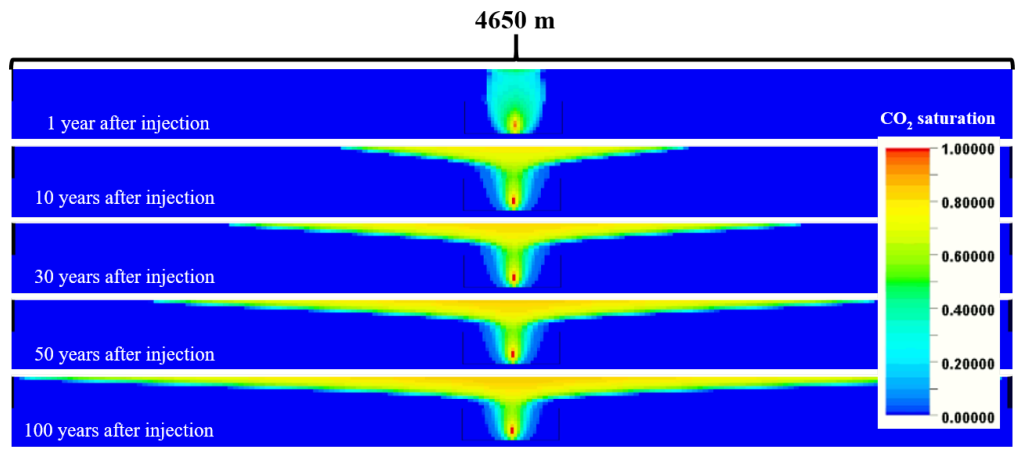
Reservoir simulation is central to predicting subsurface behavior in CO₂ sequestration and hydrogen storage systems, enabling the evaluation of injectivity, containment, and long-term performance. These simulations provide a quantitative framework for understanding multiphase flow, pressure evolution, and geochemical interactions that determine storage security. In CO₂ storage, simulation is critical for assessing plume migration and trapping mechanisms, while in hydrogen systems, it supports cyclic injection and withdrawal strategies alongside gas mixing dynamics.
Types of Reservoir Simulation Models
Reservoir simulation models can be broadly categorized into non-reactive (flow-dominated) and reactive (coupled flow-geochemistry) frameworks. Non-reactive models focus on fluid flow, pressure behavior, and transport processes, whereas reactive models incorporate chemical reactions, mineral dissolution/precipitation, and changes in reservoir properties. Comparative studies highlight that reactive transport simulators significantly differ in their ability to capture geochemical feedback mechanisms essential for long-term storage predictions.
Importance of Simulation in Subsurface Decision-Making
Simulation outputs directly inform field development strategies, risk assessment, and regulatory compliance. The selection between reactive and non-reactive models is therefore not merely technical but strategic, influencing project economics and safety outcomes.
Understanding Reactive Reservoir Simulation
Definition and Key Principles of Reactive Simulation
Reactive reservoir simulation involves coupling fluid flow equations with geochemical reaction kinetics and thermodynamics. These models account for interactions between injected fluids and reservoir rock, altering porosity, permeability, and fluid composition over time. Foundational work demonstrates that reactive transport modeling is essential when chemical processes influence flow behavior and storage capacity.
Geochemical Reactions and Fluid-Rock Interactions
Reactive simulations capture processes such as mineral dissolution, precipitation, ion exchange, and microbial activity. These interactions can significantly modify reservoir properties, particularly in CO₂ storage where mineral trapping enhances long-term security. Advanced modeling frameworks integrate compositional simulation with reactive transport formulations to accurately represent such coupled processes.
Applications in CO₂ Mineralization and Hydrogen Reactivity
Reactive simulation is indispensable in scenarios involving CO₂ mineralization and hydrogen reactivity. For CO₂, mineral trapping mechanisms require detailed geochemical modeling over extended timescales. In hydrogen storage, microbial consumption and geochemical reactions necessitate reactive modeling to ensure storage efficiency and predict losses.
Understanding Non-Reactive Reservoir Simulation
Definition and Assumptions of Non-Reactive Models
Non-reactive reservoir simulation assumes that fluid flow and transport occur without significant chemical alteration of the reservoir. These models rely on governing equations for multiphase flow and pressure dynamics, neglecting geochemical feedback mechanisms.
Fluid Flow and Pressure Dynamics Without Chemical Reactions
Non-reactive models are particularly effective for analyzing pressure behavior, fluid displacement, and flow pathways. They provide computationally efficient solutions for operational decision-making, especially when chemical reactions have negligible impact on reservoir performance.
Typical Use Cases in Gas Storage and Flow Modeling
These models are widely used in hydrogen storage operations where short-term injection and withdrawal cycles dominate, and geochemical effects are minimal. They are also applicable in early-stage feasibility studies and screening analyses.
Key Differences Between Reactive and Non-Reactive Simulation
Modeling Complexity and Computational Requirements
Reactive simulations are computationally intensive due to the coupling of multiple physical and chemical processes. Efficient modeling approaches have been developed to reduce computational costs while maintaining accuracy. In contrast, non-reactive models are less complex and faster to execute.
Data Requirements and Input Parameters
Reactive models require extensive geochemical and thermodynamic data, whereas non-reactive models primarily depend on geological and petrophysical inputs. This difference significantly influences model selection in data-limited environments.
Impact on Prediction Accuracy and Uncertainty
Reactive models offer higher accuracy in scenarios where chemical processes influence reservoir behavior but introduce additional uncertainty due to parameter sensitivity. Non-reactive models provide robust predictions for flow-dominated systems with lower uncertainty in input parameters.
When to Use Reactive Reservoir Simulation
CO₂ Storage with Geochemical Trapping Mechanisms
Reactive simulation is essential for modeling CO₂ mineralization and long-term trapping mechanisms. Studies demonstrate that geochemical reactions significantly enhance storage security and must be included in predictive models.
Hydrogen Storage in Reactive Geological Formations
In formations where hydrogen interacts with minerals or microbes, reactive modeling is necessary to account for gas losses and changes in reservoir properties.
Long-Term Storage and Mineralization Studies
Reactive models are critical for long-term predictions spanning decades to millennia, particularly for regulatory compliance and environmental risk assessment.
When to Use Non-Reactive Reservoir Simulation
Short-Term Injection and Withdrawal Operations
Non-reactive models are suitable for operational simulations involving cyclic injection and withdrawal, where chemical reactions are negligible.
Pressure Management and Flow Optimization
These models are effective for optimizing injection rates, managing reservoir pressure, and evaluating flow dynamics.
Screening Studies and Early-Stage Feasibility Analysis
Non-reactive simulations provide rapid insights during early project stages, enabling efficient screening of potential storage sites.
Hybrid Modeling Approaches
Combining Reactive and Non-Reactive Simulation Techniques
Hybrid approaches integrate reactive and non-reactive models to balance accuracy and computational efficiency. These methods allow selective application of geochemical modeling where necessary.
Sequential vs Coupled Modeling Workflows
Sequential workflows apply non-reactive models followed by reactive analysis, while fully coupled approaches integrate both simultaneously. Each approach offers trade-offs in accuracy and computational demand.
Benefits of Hybrid Simulation in Complex Reservoirs
Hybrid models provide a practical solution for complex reservoirs, capturing essential geochemical effects without excessive computational cost.
Data Requirements for Simulation Selection
Geological and Petrophysical Data Needs
Accurate geological and petrophysical data form the foundation of both reactive and non-reactive models.
Geochemical and Thermodynamic Data Requirements
Reactive models require detailed geochemical datasets, including reaction kinetics and equilibrium constants.
Sensitivity to Data Availability and Quality
Model selection is highly sensitive to data availability, with reactive models requiring more comprehensive datasets.
Computational Considerations and Performance Trade-Offs
Simulation Runtime and Resource Requirements
Reactive simulations demand significant computational resources, often requiring high-performance computing environments.
High-Performance Computing and Cloud Solutions
Advances in computing technologies are enabling large-scale simulations and reducing runtime constraints.
Balancing Accuracy and Efficiency
The choice between reactive and non-reactive models often involves balancing accuracy with computational efficiency.
Risk Assessment and Decision-Making Implications
Impact on Storage Security and Containment Assurance
Reactive models provide detailed insights into containment mechanisms, enhancing storage security assessments.
Uncertainty Quantification and Scenario Analysis
Both modeling approaches support uncertainty analysis, though reactive models capture additional sources of uncertainty related to geochemical processes.
Regulatory Expectations for Simulation Approaches
Regulatory frameworks increasingly require reactive modeling for long-term storage projects, particularly for CO₂ sequestration.
Industry Applications and Case Studies
CO₂ Sequestration Projects Using Reactive Models
Reactive models have been successfully applied in large-scale CO₂ storage projects, demonstrating their importance in long-term risk assessment.
Hydrogen Storage Projects Using Non-Reactive Models
Non-reactive models are commonly used in hydrogen storage operations focused on short-term performance and operational efficiency.
Lessons Learned from Integrated Simulation Workflows
Integrated workflows highlight the importance of selecting the appropriate modeling approach based on project objectives and data availability.
Common Mistakes in Simulation Selection
Overcomplicating Models Without Justification
Using reactive models unnecessarily can increase computational cost without improving accuracy.
Ignoring Critical Geochemical Processes
Conversely, neglecting geochemical reactions in relevant scenarios can lead to inaccurate predictions.
Misalignment Between Model Type and Project Objectives
Selecting the wrong modeling approach can compromise project outcomes and decision-making.
Best Practices for Choosing the Right Simulation Approach
Aligning Simulation Type with Project Goals
Model selection should be driven by project objectives, time horizon, and risk profile.
Iterative Modeling and Validation Strategies
Iterative workflows improve model accuracy and reliability.
Collaboration Between Geoscientists and Engineers
Multidisciplinary collaboration ensures that models are both geologically realistic and operationally relevant.
Future Trends in Reservoir Simulation for Energy Storage
AI-Enhanced Reactive Transport Modeling
AI is enhancing reactive modeling by improving prediction accuracy and reducing computational requirements.
Real-Time Simulation and Digital Twin Integration
Digital twins enable real-time monitoring and adaptive simulation, improving operational decision-making.
Advances in Multiphysics Modeling Frameworks
Future models will integrate multiple physical and chemical processes, providing more comprehensive predictions.
Final Decision Framework for Simulation Selection
Technical Criteria for Model Selection
Selection criteria include reservoir characteristics, data availability, and project objectives.
Cost vs Accuracy Evaluation
Balancing cost and accuracy is essential for effective model selection.
Integration with Project Lifecycle Stages
Different modeling approaches are required at different stages of the project lifecycle.
Frequently Asked Questions
What is the difference between reactive and non-reactive reservoir simulation?
Reactive simulation includes geochemical reactions and fluid-rock interactions, while non-reactive simulation focuses on fluid flow and pressure behavior without chemical changes.
When should reactive simulation be used in CO₂ storage projects?
Reactive simulation is required when modeling geochemical trapping mechanisms and long-term storage behavior.
Why is non-reactive simulation preferred for hydrogen storage operations?
Non-reactive simulation is preferred for short-term operations where flow dynamics dominate and chemical reactions are minimal.
What data is required for reactive reservoir simulation models?
Reactive models require geological, petrophysical, geochemical, and thermodynamic data.
How do geochemical reactions affect reservoir simulation outcomes?
They alter reservoir properties such as porosity and permeability, impacting flow behavior and storage capacity.
Can reactive and non-reactive models be combined in one workflow?
Yes, hybrid approaches combine both methods to balance accuracy and computational efficiency.
What are the computational challenges of reactive simulation?
Reactive simulations are computationally intensive due to coupled physical and chemical processes.
How does simulation choice impact regulatory approval for storage projects?
Regulators often require reactive modeling for long-term storage assurance and risk assessment.
What are common mistakes when selecting a simulation approach?
Common mistakes include overcomplicating models or ignoring critical geochemical processes.
How do engineers decide between model accuracy and computational efficiency?
They evaluate project requirements, data availability, and computational resources to select the most appropriate approach.
References
Addassi, M., Omar, A., Ghorayeb, K., & Hoteit, H. (2021). Comparison of various reactive transport simulators for geological carbon sequestration. International Journal of Greenhouse Gas Control, 110, 103419. https://doi.org/10.1016/j.ijggc.2021.103419
Audigane, P., Gaus, I., Czernichowski-Lauriol, I., Pruess, K., & Xu, T. (2007). Two-dimensional reactive transport modeling of CO₂ injection in a saline aquifer at the Sleipner site, North Sea. American Journal of Science, 307(7), 974–1008. https://doi.org/10.2475/07.2007.02
Farshidi, S. F. (2016). Compositional reservoir simulation-based reactive-transport formulations, with application to CO₂ storage in sandstone and ultramafic formations (Doctoral dissertation). Stanford University. https://pangea.stanford.edu/ERE/pdf/pereports/PhD/Farshidi2016.pdf
Hogeweg, S. (2024). Bio-geo-reactive simulation of underground hydrogen storage. Frontiers in Energy Research. https://doi.org/10.3389/fenrg.2024.1385273
Machado, M. V. B., Delshad, M., & Sepehrnoori, K. (2024). A computationally efficient approach to model reactive transport during CO₂ storage in naturally fractured saline aquifers. Geoenergy Science and Engineering. https://doi.org/10.1016/j.geoen.2024.212768
Matini, F. (2025). Coupled reactive transport modeling for underground hydrogen storage using MRST and PHREEQC (Master’s thesis). Politecnico di Milano.
Moslehi, S. (2025). Reactive transport modeling of hydrogen storage in depleted gas fields. Advances in Geo-Energy Research. https://doi.org/10.46690/ager.2025.05.04
Nguyen, B. N. (2016). Three-dimensional modeling of reactive transport of CO₂ in geological formations. International Journal of Greenhouse Gas Control, 47, 1–15.
Porbar, A. J., Afarideh, H., & Rashidi, F. (2025). Simulation-based reservoir analysis assisted by chemical tracers transport for the development of enhanced oil recovery strategies. Scientific Reports, 15, 43790. https://doi.org/10.1038/s41598-025-27755-7
Xu, T. (2012). Reactive transport modeling for CO₂ geological storage. Energy Procedia, 4, 3539–3546. https://doi.org/10.1016/j.petrol.2011.09.005
Zhang, Y., et al. (2025). Experimental and numerical investigation of hydrogen reactive transport in porous media. Energy & Fuels. https://doi.org/10.1021/acs.energyfuels.5c04695